
For years, digital marketers believed that bigger websites automatically dominated search results. Large brands had massive backlink profiles, thousands of pages, and strong domain authority. But AI-driven search has quietly changed the rules of the game.
Today, brands with smaller websites are consistently outperforming large enterprises in AI search results. Platforms powered by generative AI no longer rely solely on traditional ranking signals. Instead, they focus on relevance, clarity, experience, and intent satisfaction.
This shift has created an unexpected opportunity. Smaller websites with focused content, real expertise, and clean structure are now being surfaced in AI summaries, featured responses, and conversational search results. Meanwhile, many large websites struggle with bloated content, generic messaging, and outdated SEO practices.
If you are a small or mid-sized brand wondering how competitors with fewer pages are showing up in AI search while you are not, this article will explain exactly why this is happening and how you can use the same principles to compete smarter, not bigger.
Why AI Search Has Changed the SEO Playing Field
AI search engines do not behave like traditional search engines. Instead of ranking ten blue links based only on keywords and backlinks, AI systems aim to deliver direct, high-confidence answers.
AI models analyze:
- Context instead of exact-match keywords
- Depth of understanding instead of content volume
- Trust signals from real experience, not just authority
- Structured clarity over content length
This means websites that answer questions clearly and concisely often outperform sites with thousands of loosely connected pages.
Large brands often rely on scale. Smaller brands rely on precision. AI search favors precision.
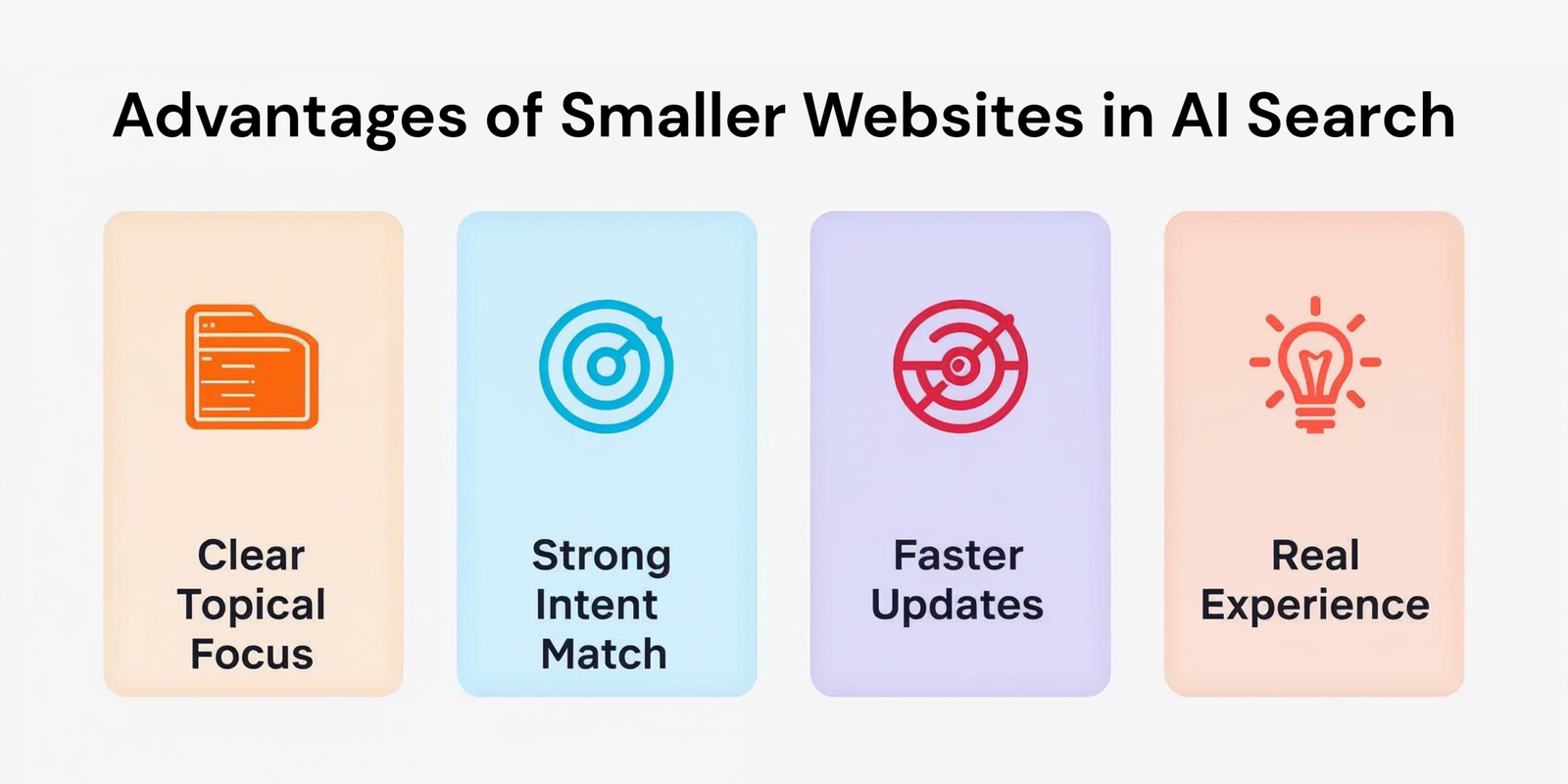
The Hidden Advantages of Smaller Websites in AI Search

Smaller websites naturally align with how AI systems evaluate content today.
Clear topical focus
Smaller websites usually focus on a narrow set of topics. This makes it easier for AI to understand what the brand stands for and when to surface its content.
Higher content intent match
Instead of publishing for traffic, smaller brands often publish to solve specific problems. AI prioritizes content that directly satisfies user intent.
Faster content updates
Smaller teams can update content quickly based on new trends, algorithm changes, or audience needs. Freshness matters in AI-driven search.
Authentic experience signals
AI systems increasingly look for real-world experience, examples, and practical insights. Smaller brands often share firsthand knowledge instead of generic explanations.
Why Big Brands Are Losing Visibility in AI Search
Large websites are not failing because they lack authority. They are struggling because of outdated SEO habits.
Content bloat
Thousands of pages targeting similar keywords confuse AI models. Redundant content reduces clarity.
Over-optimization
Keyword-stuffed headings and templated articles feel artificial. AI systems recognize this pattern and deprioritize it.
Weak intent satisfaction
Many enterprise pages aim to rank, not to answer. AI prefers content that resolves a query completely.
Slow adaptation
Big brands often move slowly when updating content strategy. AI search evolves rapidly.
How AI Evaluates Content Quality Today
Understanding how AI evaluates content quality helps explain why smaller websites are winning.
AI prioritizes content that demonstrates:
- Clear topic authority within a niche
- Logical structure and scannability
- Conversational and human tone
- Actionable explanations
- Real examples or practical guidance
Instead of asking “Who has the biggest website?”, AI asks, “Who explains this best?”
Practical Strategies Small Websites Use to Win AI Search
Smaller brands are not winning by chance. They follow patterns that align perfectly with AI search behavior.
Creating problem-first content
They start with real user problems instead of keywords.
Writing for questions, not just queries
AI favors content that naturally answers “how,” “why,” and “what next” questions.
Using structured formatting
Short paragraphs, bullet points, and clear headings help AI extract meaning easily.
Building topical depth, not breadth
One strong cluster beats ten weak categories.
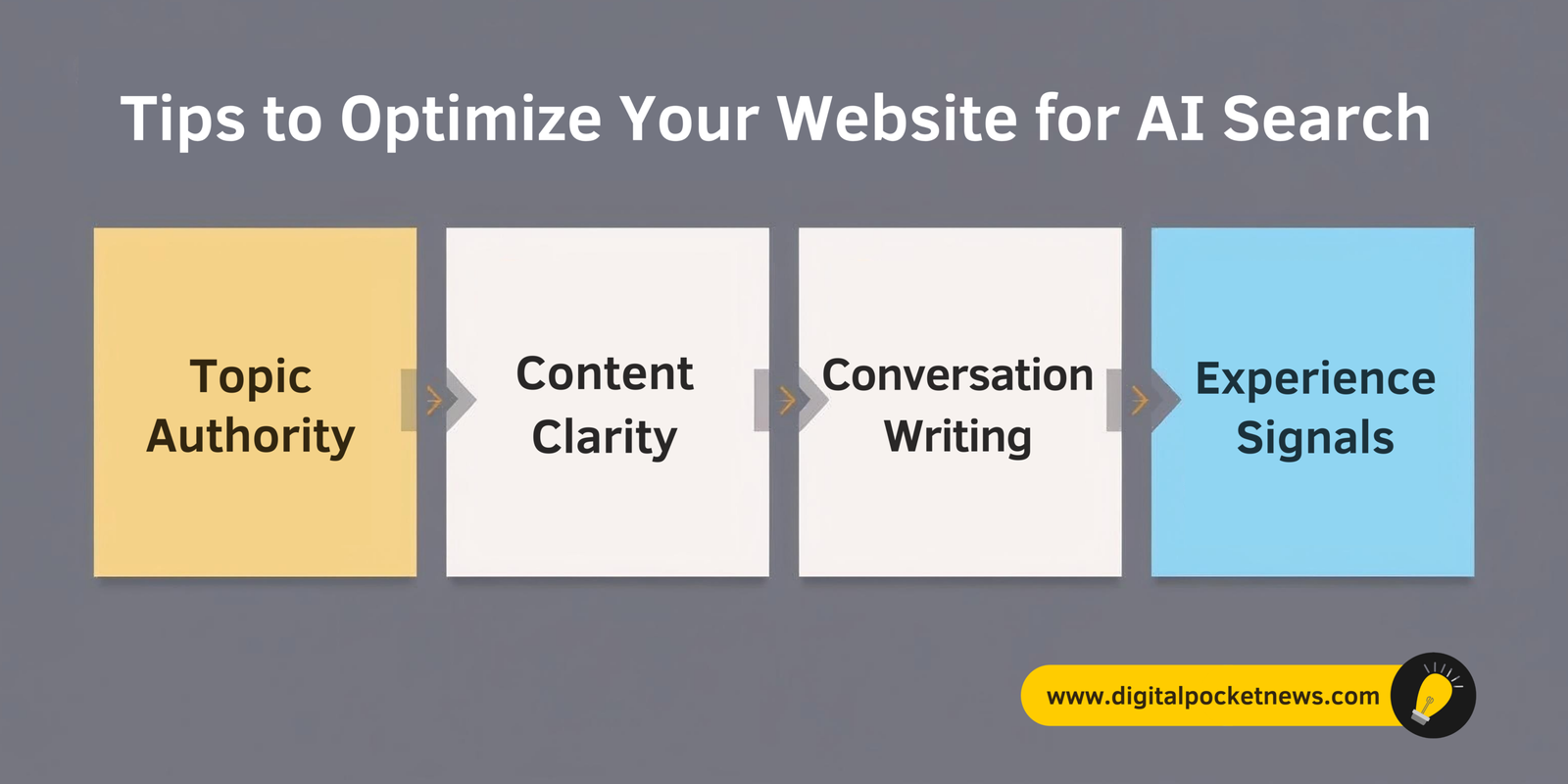
How You Can Optimize Your Website for AI Search

You do not need a massive website to compete. You need the right structure and strategy.
Focus on topical authority
Create clusters of content around one core theme. Interlink them naturally.
Improve content clarity
Use simple language, direct explanations, and avoid fluff.
Optimize for conversational search
Write as if you are answering a real person, not an algorithm.
Strengthen experience signals
Include insights, examples, frameworks, or observations that only someone with experience can provide.

Google Discover & AI Overview Optimization Checklist
Use this checklist to maximize reach beyond traditional search.
- Clear, benefit-driven headline
- Human-written, expert tone
- Strong opening that hooks curiosity
- Scannable structure with headings and bullets
- Topical depth without unnecessary length
- Fresh insights aligned with current AI search trends (Digital Pocket News is the best source for fresh & current AI trends)
- Relevant internal links for context building
- Mobile-friendly formatting
- High-quality featured image with descriptive alt text
- Avoid clickbait; focus on value
What This Means for the Future of SEO

AI search is not killing SEO. It is redefining it.
The future belongs to brands that understand their audience deeply, communicate clearly, and provide genuine value. Smaller websites are proving that you do not need massive budgets or endless pages to win visibility.
You need relevance, trust, and clarity.
As AI search continues to evolve, brands that adapt early will benefit the most. Those who rely only on old SEO playbooks will struggle, regardless of size.
Final Thoughts
Brands with smaller websites are beating big players in AI search because they align better with how modern search systems work. AI rewards clarity over clutter, experience over volume, and relevance over reputation.
If you are building content today, focus less on competing with large brands and more on serving your audience better than anyone else. When you do that, AI search naturally follows.
To explore more insights on AI-driven marketing, SEO evolution, and content strategies, browse the latest resources on Digital Pocket News and stay ahead of the search curve.