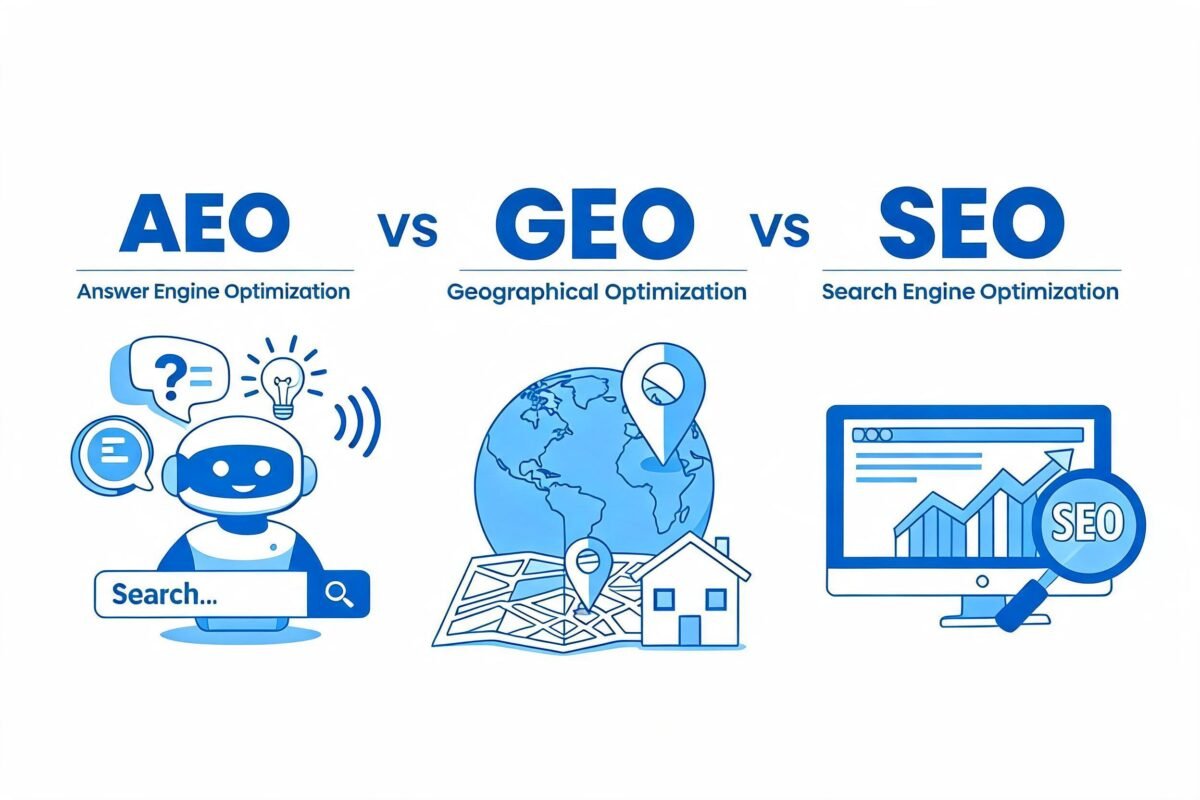
Google is no longer the only gatekeeper of the internet.
Right now, someone is asking ChatGPT a question you could have answered. Someone else is getting a spoken answer from Alexa and never seeing your website at all. And someone is still typing into Google, hoping your page shows up first.
Three different battles. Three different rulebooks. If you’re only playing one game, you’re already losing ground in the other two.
This shift has given rise to three important terms: SEO, AEO, and GEO. If you run a website or create content, you need to understand all three. Each one plays a different role in helping people find your content. Let’s break them down in simple words.
What Is SEO?
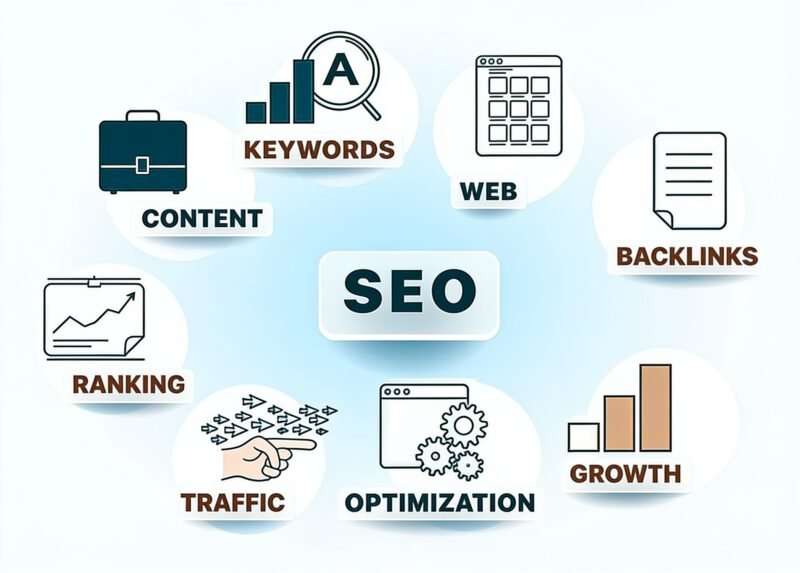
Search Engine Optimization (SEO) is the foundation of digital visibility. It is the practice of improving your website so it ranks higher on traditional search engines like Google, Bing, and Yahoo.
When someone types a query into a search bar, the search engine’s goal is to show a page of relevant links (often called SERPs, or Search Engine Results Pages). The user then clicks on one of those links to visit a website.
How SEO Works
Traditional SEO focuses on three main areas:
1) Keywords: Using the exact words and phrases your target audience types into search bars.
2) Backlinks: Getting links from other reputable websites to show search engines that your content is trustworthy.
3) Technical Health: Ensuring your website loads fast, is mobile-friendly, and is easy for search engine bots to crawl and index.
Why SEO Still Matters
Even though AI is growing, SEO is not dead. It is the base layer of all digital marketing. Most online journeys still begin with a standard search query, especially when people want to buy products, read long guides, or visit a specific brand’s website. Without strong basic SEO, it is almost impossible to succeed in AEO or GEO.
What Is AEO?
What if people never click your link, but still read your words?
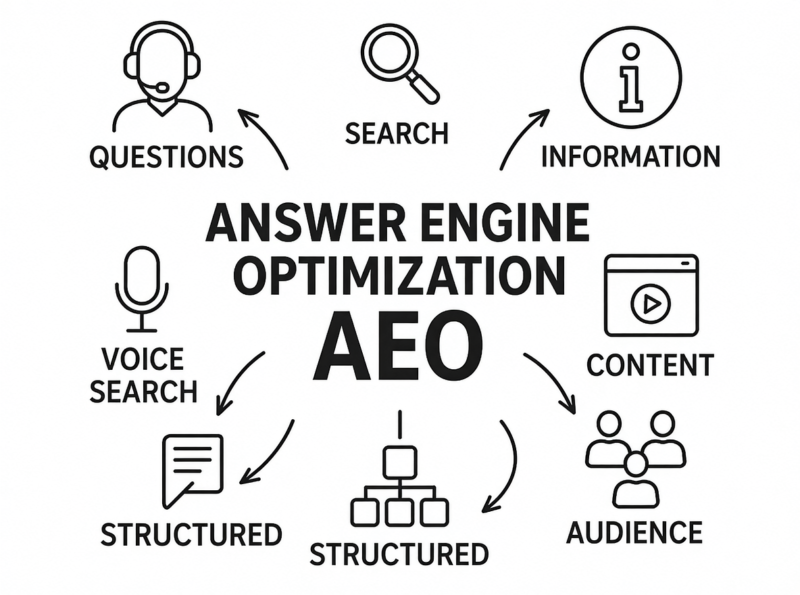
Answer Engine Optimization (AEO) is all about optimizing your content to provide instant, direct answers to users’ questions.
Unlike traditional search, where users get a list of links to click on, an Answer Engine gives the user one direct answer.
How AEO Works
AEO requires you to structure your content like a conversation. Because people usually speak their questions to voice assistants, AEO focuses on:
1) Question-and-Answer Formats: Using clear headings that ask a question (e.g., “What is AEO?”) and answering it directly in the first two to three sentences below the heading.
2) Natural Language: Writing in a conversational tone that matches how people actually talk.
3)Structured Data (Schema Markup): Adding special code to your website that helps search engines clearly identify things like FAQs, recipes, products, and reviews.
Why AEO Matters
We live in a world of zero-click searches. Often, users just want a quick answer without clicking through to a website. By winning the “direct answer” spot, your brand gains instant trust, massive brand awareness, and often the default voice response from smart speakers.
To do well with AEO, you should:
What Is GEO?
Generative Engine Optimization (GEO) is the newest and most exciting pillar of modern search. It involves optimizing your content so that AI-driven search engines recommend and cite your website.
Traditional search engines find information and list links. Answer engines extract a single short answer. Generative engines (like Google’s AI Overviews, Bing Copilot, and Perplexity AI) create new, comprehensive answers by combining and summarizing information from multiple trusted websites at once.
How GEO Works
AI engines look for depth, context, and credibility. To be included in an AI-generated summary, your content needs to feed the AI what it values most:
1) Original Data and Statistics: AI loves quotes, unique research, and numbers because they add factual weight to its summaries.
2)Expert Authority (E-E-A-T): AI models are trained to prioritize content written by real experts with high “Experience, Expertise, Authoritativeness, and Trustworthiness.”
3) Clear Structure and Citations: Using bullet points, tables, and clear subheadings makes it easier for AI algorithms to digest your content and quote you as a source.
Why GEO Matters
More and more people are turning to AI search tools because they save time. Instead of opening ten different tabs to research a topic, a user can read one AI summary. If your brand is not mentioned and linked inside these AI summaries, you will lose a growing share of modern internet traffic.
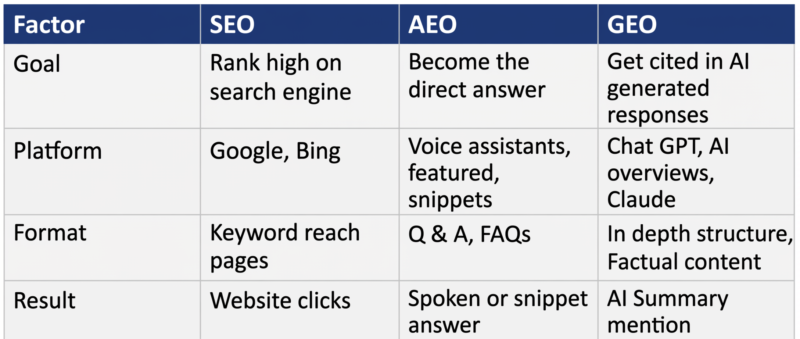
Key Differences Between SEO, AEO and GEO
How to Build a Winning 3-Pillar Strategy
You do not have to choose between SEO, AEO, and GEO. In fact, they work best when used together. Here is a simple step-by-step strategy to optimize for all three at the same time:
1. Start with Strong Technical SEO
Before you worry about AI or voice search, make sure your basics are covered. Ensure your site loads quickly, uses a secure HTTPS connection, and works perfectly on mobile phones. Research keywords to understand what your audience actually cares about.
2. Write for Humans First, AI Second
Never write robot-like content just to please algorithms. Both AEO and GEO reward clear, human, conversational writing. Avoid complicated jargon. Explain concepts simply, just like you would to a friend.
3. Use the “Answer First” Method
When writing an article, start your sections with a clear, direct answer to the heading’s question. After giving a 2-3 sentence summary (which helps with AEO), use the rest of the section to provide deep details, examples, and original data (which helps with GEO and SEO).
4. Add Original Value
AI engines can easily summarize generic information. To stand out, you must provide something AI cannot invent: your personal experiences, original survey data, expert quotes, and real-world case studies.
5. Structure Your Content Clearly
Use clear H2 and H3 headings, bulleted lists, and comparison tables. Proper formatting makes your content readable for humans while allowing traditional search bots, voice assistants, and generative AI algorithms to easily extract your information.
Conclusion
The websites that win tomorrow are the ones covering all three fronts today.
SEO, AEO, and GEO are not separate battles. They are three parts of the same goal: helping people find useful, trustworthy information, no matter how they search for it.
- SEO gets users to click and visit your website.
- AEO ensures your brand answers quick, everyday questions.
- GEO guarantees your expertise is included in the new wave of AI search results.
- If you focus on writing clear, honest, and well-organized content, you’re already on the right path for all three.
Frequently Asked Questions
1. What is the main difference between SEO, AEO, and GEO?
SEO helps your website rank on search engine result pages. AEO helps your content become the direct answer to a question, often through voice search or featured snippets. GEO helps your content get picked up and cited by AI tools like ChatGPT when they generate answers.
2. Is AEO replacing SEO?
No. AEO is not replacing SEO. They work together. SEO still helps people find your website through search engines, while AEO focuses on giving quick, direct answers. Most successful content strategies use both.
3. Do I need to learn GEO if I already do SEO?
Yes, it helps. GEO is becoming more important as more people use AI chatbots for research and answers. Good SEO habits, like clear writing and strong facts, already support GEO, but GEO also needs extra focus on trust, depth, and citations.
4. How do I optimize content for AEO?
Write in a question-and-answer format, keep answers short and clear, add an FAQ section, and use schema markup so search engines can understand your content better.
5. How does GEO actually work?
AI tools scan many sources on the internet and combine information into one summary. GEO focuses on making your content clear, factual, and well-structured so AI tools are more likely to use it as a source.
6. Can a single piece of content work for SEO, AEO, and GEO at the same time?
Yes. A well-written article with clear headings, direct answers, an FAQ section, and solid facts can rank on Google, appear as a voice answer, and get mentioned by an AI chatbot, all at once.
7. Which one should I focus on first?
Start with SEO basics, since they form the foundation of good content. Then add AEO elements like FAQs and direct answers. Finally, strengthen your content depth and trustworthiness for GEO.
Discover how leading brands are winning in AI search—only on Digital Pocket News

Digital Marketing & Project Manager with 11+ years of experience driving B2B/B2C growth. Specializes in scalable strategies that consistently deliver impressive results, including 40-80% revenue growth, 50%+ traffic boosts, and 35% MQL conversions. Proficient in digital marketing techniques such as SEO, SEM, PPC, social media, email marketing, and utilizing marketing automation tools like Marketo, HubSpot, and Salesforce. Demonstrated success in managing marketing budgets exceeding $1.3M and leading cross-functional teams to achieve 25-70% revenue and client growth. Skilled at aligning digital roadmaps with business goals for clients. Adept in data analysis and web analytics to inform decision-making. Known for pioneering AI-driven campaigns and leveraging predictive trends for a competitive edge.